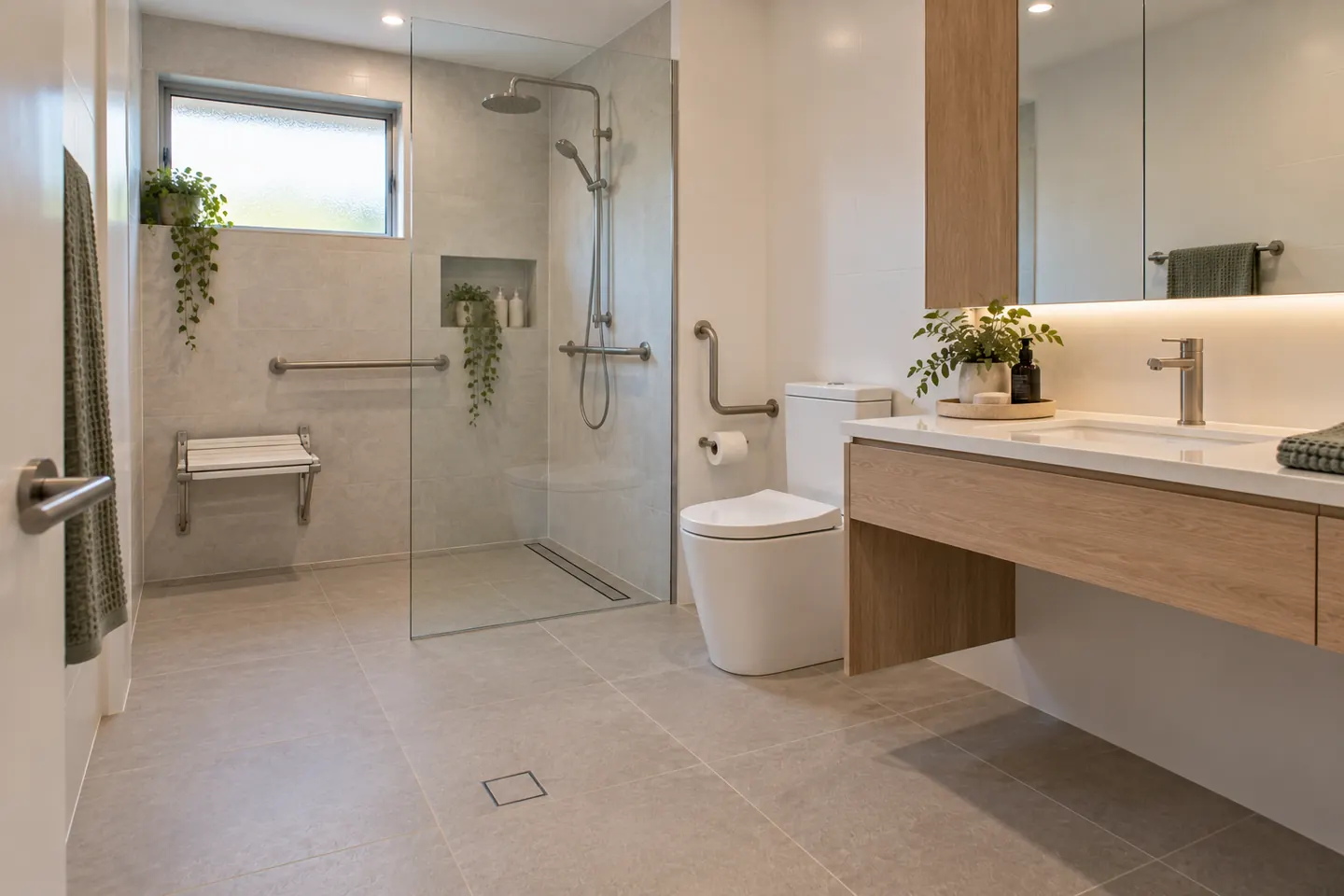
Designing for later, now
Many Shire households have lived in the same home for decades and plan to stay. A bathroom renovation is the ideal time to build in features that make the room safer and easier — even if they are not needed yet.
Features that matter
Step-free shower. No hob, no tray, a linear drain, and a floor that falls properly.
Blocking in the walls. Timber or steel behind the tiles so rails can be fitted anywhere, anytime.
Grab rails. Where needed now — in the shower, beside the toilet — in finishes that look like good hardware, not hospital fittings.
Shower seat. Fold-down or fixed.
Handheld shower on a rail. Adjustable for sitting or standing.
Slip-resistant tiles. Suitable for wet areas, in matte finishes.
Lever tapware. Easier than cross-handles.
Lighting. Bright and even, with a soft night light.
Space and doors. Wider doorways and room to turn where practical.
Looks matter
Accessible does not have to mean clinical. Matching rails to tapware, using warm materials and hiding blocking behind tiles gives a bathroom that simply looks well designed.
Working with occupational therapists
Where a specific need exists, an OT assessment helps set rail heights, seat positions and clearances. Funding programs often require one.
Costs
Typically similar to a standard renovation plus a modest allowance for features. See the 2026 cost bands.
Call 02 4307 5309 or send the room details through.
Questions people ask before they commit
What makes a bathroom accessible?
Common features include a step-free walk-in shower with a linear drain, grab rails or reinforced walls ready for them, a fold-down or fixed shower seat, a handheld shower on a rail, slip-resistant floor tiles, wider doorways, lever tapware, good even lighting and enough clear floor space to move with a walker or wheelchair.
Do I need an occupational therapist?
For specific mobility needs, an occupational therapist's assessment helps get dimensions, rail positions and fixture heights right. Where funding such as aged care or disability support is involved, a formal assessment is often required.
Can I add grab rails later?
Only if the wall can take the load. The cheapest time to add timber or steel blocking behind the tiles is during the renovation, even if rails are not fitted yet.
Does an accessible bathroom cost more?
Usually only modestly more than a standard renovation of the same size. The main extras are a step-free shower floor, blocking, rails and a seat. Widening doorways or enlarging the room adds more.